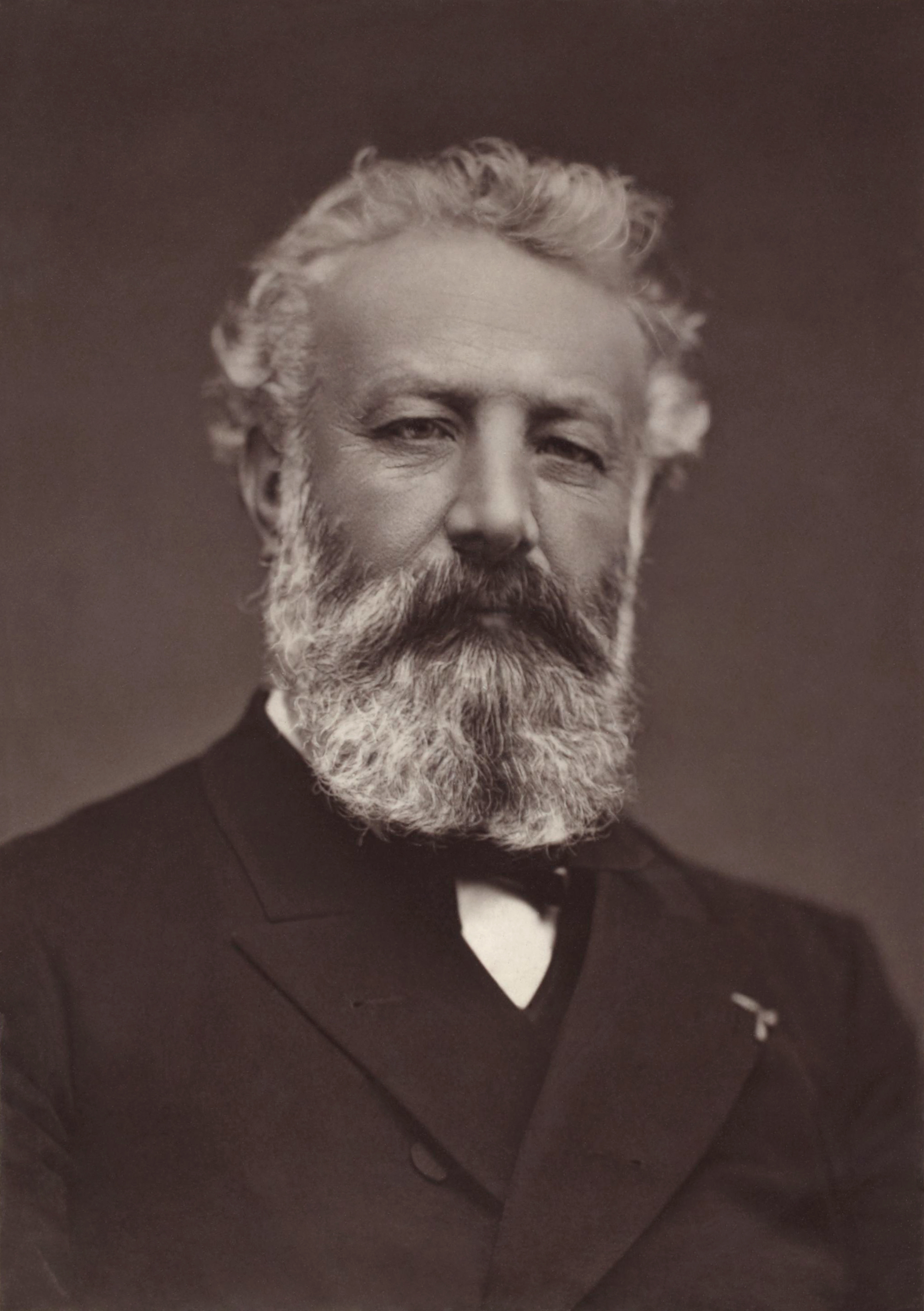
Jules Verne
১ টি রচনা
Jules Gabriel Verne ( VURN; French: [ʒyl ɡabʁijɛl vɛʁn]; 8 February 1828 – 24 March 1905) was a French novelist, poet, and playwright. His collaboration with the publisher Pierre-Jules Hetzel led to the creation of the Voyages extraordinaires, a series of bestselling adventure novels including Journey to the Center of the Earth (1864), Twenty Thousand Leagues Under the Seas (1870), and Around the World in Eighty Days (1872). His novels are generally set in the second half of the 19th century, taking into account contemporary scientific knowledge and the technological advances of the time. In addition to his novels, he wrote numerous plays, short stories, autobiographical accounts, poetry, songs, and scientific, artistic and literary studies. His work has been adapted for film and television since the beginning of cinema, as well as for comic books, theater, opera, music and video games. Verne is considered to be an important author in France and most of Europe, where he has had a wide influence on the literary avant-garde and on surrealism. His reputation was markedly different in the Anglosphere where he had often been labeled a writer of genre fiction or children's books, largely because of the highly abridged and altered translations in which his novels have often been printed. Since the 1980s, his literary reputation has improved. Jules Verne has been the second most-translated author in the world since 1979, ranking below Agatha Christie and above William Shakespeare. He has sometimes been called the "father of science fiction", a title that has also been given to H. G. Wells and Hugo Gernsback. In the 2010s, he was the most translated French author in the world. In France, 2005 was declared "Jules Verne Year" on the occasion of the centenary of the writer's death.
=== Early life === Verne was born on 8 February 1828, on Île Feydeau, a then small artificial island on the river Loire within the town of Nantes (later filled in and incorporated into the surrounding land area), in No. 4 Rue Olivier-de-Clisson, the house of his maternal grandmother Dame Sophie Marie Adélaïde Julienne Allotte de La Fuÿe (born Guillochet de La Perrière). His parents were Pierre Verne, an avoué originally from Provins, and Sophie Allotte de La Fuÿe, a Nantes woman from a local family of navigators and shipowners, of distant Scottish descent. In 1829, the Verne family moved some hundred metres away to No. 2 Quai Jean-Bart, where Verne's brother Paul was born the same year. Three sisters, Anne "Anna" (1836), Mathilde (1839), and Marie (1842), followed. In 1834, at the age of six, Verne was sent to boarding school at 5 Place du Bouffay in Nantes. The teacher, Madame Sambin, was the widow of a naval captain who had disappeared some 30 years before. Madame Sambin often told the students that her husband was a shipwrecked castaway and that he would eventually return like Robinson Crusoe from his desert island paradise. The theme of the robinsonade would stay with Verne throughout his life and appear in many of his novels, some of which include The Mysterious Island (1874), The Castaways of the Flag (1900), and The School for Robinsons (1882). In 1836, Verne went on to École Saint‐Stanislas, a Catholic school suiting the pious religious tastes of his father. Verne quickly distinguished himself in mémoire (recitation from memory), geography, Greek, Latin, and singing. In the same year, 1836, Pierre Verne bought a vacation house at 29 Rue des Réformés in the village of Chantenay (now part of Nantes) on the Loire. In his brief memoir Souvenirs d'enfance et de jeunesse (Memories of Childhood and Youth, 1890), Verne recalled a deep fascination with the river and with the many merchant vessels navigating it. He also took vacations at Brains, in the house of his uncle Prudent Allotte, a retired shipowner, who had gone around the world and served as mayor of Brains from 1828 to 1837. Verne took joy in playing interminable rounds of the Game of the Goose with his uncle, and both the game and his uncle's name would be memorialized in two late novels (The Will of an Eccentric (1900) and Robur the Conqueror (1886), respectively). Legend has it that in 1839, at the age of 11, Verne secretly procured a spot as cabin boy on the three-mast ship Coralie with the intention of traveling to the Indies and bringing back a coral necklace for his cousin Caroline. The evening the ship set out for the Indies, it stopped first at Paimbœuf where Pierre Verne arrived just in time to catch his son and make him promise to travel "only in his imagination". It is now known that the legend is an exaggerated tale invented by Verne's first biographer, his niece Marguerite Allotte de La Fuÿe, though it may have been inspired by a real incident.
জুল ভার্ন